Military
59 items. Click any to view full size.
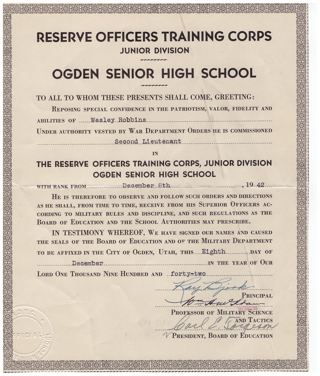
Ogden High ROTC Commissioned 2nd Lieutenant
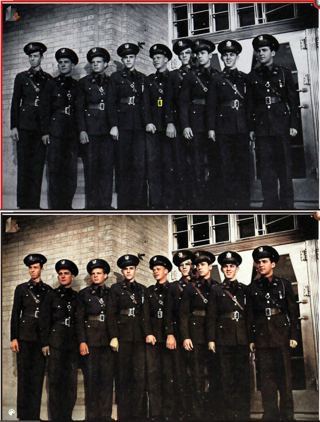
Center, Bud has the yellow buckle.
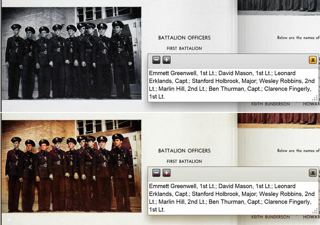
Ogden High School Yearbook, 1943
Ogden High ROTC Commissioned 2nd Lieutenant
USMC Muster Rolls
Jan 1943, Private First Class, Platoon Leaders Unit, 12th Reserve District, Mbny, Many, Mare Island, California Apr 1943, Private First Class, Platoon Leaders Unit, 12th Reserve District, Mbny, Mare Island, California Jul 1943, Private, Platoon Leaders Unit, 12th Reserve District, Mbny, Mare Island, California Jul 1943, Private, Marine Detachment, Ntu, Univ Of Colo, Boulder, Colo Oct 1943, Private, Marine Detachment, Navy V-12 Unit, Univ Of Colo, Boulder, Colo Jan 1944, Private First Class, Aviation Training Squadron One-Thirty-One, Mcad, Miramar, San Diego 45, CA Jan 1944, Private First Class, Training Squadron 23, Marine Aviation Detachment, Naval Air Technical Training Center, Norman, Oklahoma Apr 1944, Private First Class, Trsq 23, Mad, Naval Air Technical Training Center, Norman, Oklahoma Jul 1944, Sergeant, Marine Aviation Detachment, Naval Air Gunners School, Purcell, Oklahoma Oct 1944, Corporal, Mwss-2, Personnel Group, Mfairwest, Mcad, Miramar, San Diego, California (Marine Wing Support Squadron 2, Marine Fleet Air, West Coast, Marine Corps Air Depot) Oct 1944, Corporal, Hqsq-43, Mbdag-43, Marfair, Wc, Mcas, El Centre, Calif (Headquarters Squadron 43 , Marine Base Defense Air Group 43, Marine Fleet Air, West Coast, Marine Corps Air Station) Jan 1945, Corporal, : Hqsq-42, Mag-42, Marfair, West Coast, Mcas, El Centro, California (Headquarters Squadron 42, Marine Aircraft Croup 42, Marine Fleet Air, West Coast, Marine Corps Air Station) Apr 1945, Corporal, Macs-5, Personnel Group, Mfairwest, Mcad, Miramar, San Diego, California (Marine Air Control Squadron 5, Marine Fleet Air, West Coast, Marine Corps Air Station) Apr 1945, Corporal, Vmsb-464, Mag-41, U. S. Marine Corps Air Station, El Toro, Santa Ana, California (Marine Scout Bombing Squadron 464, Marine Aircraft Group 41) July 1945, Corporal, Vmtb-134, Mag-11, 4th Maw, C/O Fpo. San Francisco, California (Marine Torpedo Bombing Squadron 134, Marine Aircraft Group 11, 4th Marine Aircraft Wing) Jan 1946, Corporal, Vmtb-134, Mag-32, 1st Maw, C/O Fpo, San Francisco, California (Marine Torpedo Bombing Squadron 134, Marine Aircraft Group 32, 1st Marine Aircraft Wing) Apr 1946, Corporal, Vmtb-134, Mag-12, Mawc, Mcad, Miramar, San Diego, California (Marine Torpedo Bombing Squadron 134, Marine Aircraft Group 12, Marine Air, West Coast, Marine Corp Air Depot)
Marine Scout Bomber Squadron 464 (VMSB-464) was activated on April 15, 1944 at Marine Corps Air Station El Toro, California to train personnel. Their status changed in October of that year as they were designated a replacement training squadron. They were redesignated Marine Torpedo Bombing Squadron 464 (VMTB-464) on June 1, 1945.
Marine Scout Bombing Squadron 134 (VMSB-134) was activated on May 1, 1943 at Marine Corps Air Station Santa Barbara, California, and assigned to Marine Base Defense Aircraft Group 42, Marine Fleet Air, West Coast. Shortly thereafter it was redesignated as Marine Torpedo Bombing Squadron 134 (VMTB-134) on June 1, 1943. From October to November 1943 the squadron deployed to Espiritu Santo, New Hebrides, and detached from the Marine Base Defense Aircraft Wing. In November 1943 the squadron was reassigned to Marine Aircraft Group 11, 1st Marine Aircraft Wing. During the course of World War II the squadron supported operations on Bougainville, the Bismarck Archipelago and Peleliu. Following these campaigns the squadron went through numerous reassignments to include the following: Reassigned during January 1944 to Marine Aircraft Group 24. Reassigned during March 1944 to Marine Aircraft Group 14. Reassigned during May 1944 to Marine Aircraft Group 12. Reassigned during June 1944 to Marine Aircraft Group 11, 2nd Marine Aircraft Wing. Reassigned during December 1944 to Marine Aircraft Group 11, 4th Marine Aircraft Wing.
Following the war, VMTB-134 was assigned to Tsingtao, China during October 1945 to participate in the occupation of Northern China from October 1945 to April 1946. During this time they were again reassigned in November 1945 to Marine Aircraft Group 32, 1st Marine Aircraft Wing and to Marine Aircraft Group 12 in April 1946 upon their return from China. The squadron was deactivated on April 30, 1946.
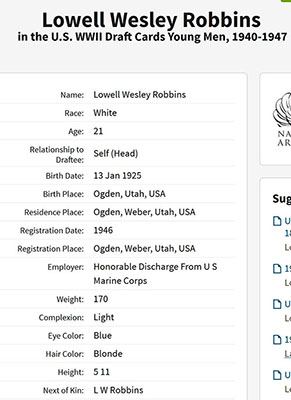
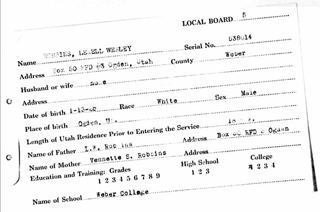
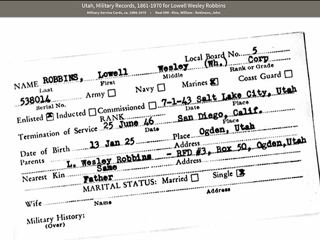
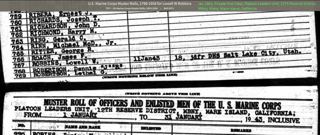
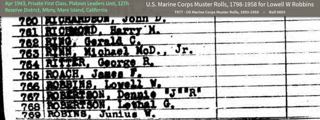

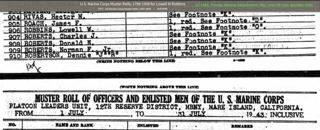




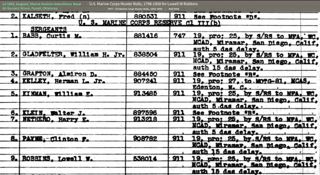
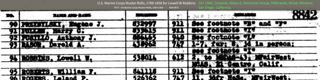

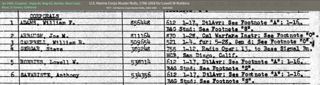


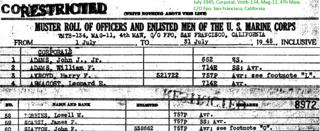
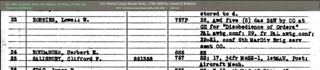

Muster Rolls
Military Record of Separation
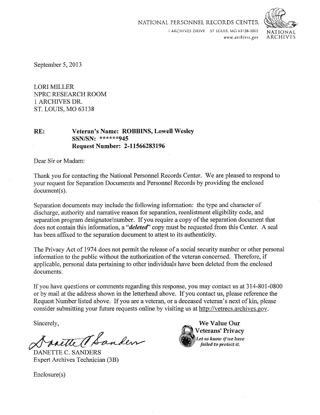
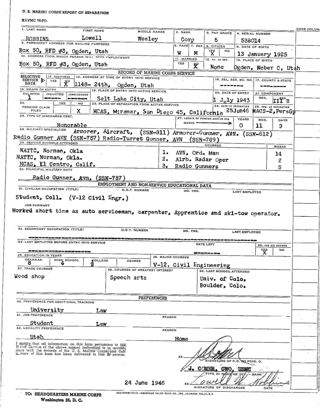
Military Record of Separation
Grumman TBM-3E Avenger (Deployed)
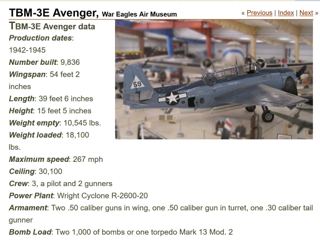
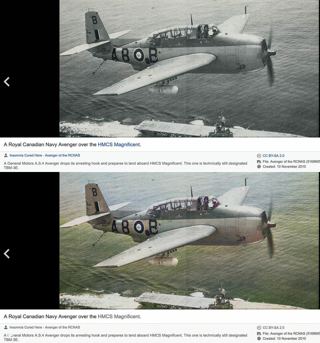
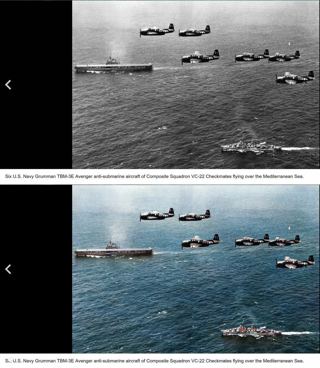
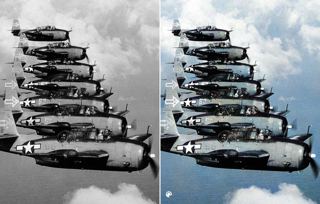
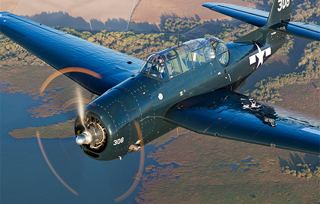
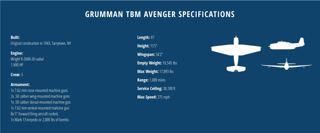
https://en.wikipedia.org/wiki/Grumman_TBF_Avenger
"Was in the Marine Air Force as a gunner in a TBM-3E Torpedo Bomber. Traveled the Pacific - Marshall Islands, Guam, Palau, Peleliu, Philippines, Okinawa and China before coming home".
Bud Robbins - quote from 50th high school reunion biography.
**Note: Bud was listed as a radio gunner on his separation papers. Below describes the 3 crew positions. Bud was position #3 as a Radio Operator/Gunner.
The “Radio Operator”. Source for Radio Operator text is from: https://www.pearlharboraviationmuseum.org/blog/mystery-middle-seat/
The figure below shows the pilot in the front as usual. Behind him was an armored bulkhead that cut his seat off from the rest of the aircraft. Except in the first model, the pilot had two forward-firing machine guns in the wings. He used these heavy machine guns to suppress antiaircraft fire from targets and to fire at incoming fighters.
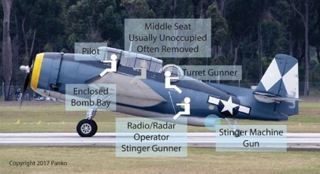
Figure: Crew Seating Positions in the Grumman TBF/TBM Avenger, Source: Annotations by Ray Panko, aircraft photo was a royalty free stock photo from Adobe.
At the back of the canopy was the turret gunner. In the Avenger, the gunner was not also the radio operator. He was kept busy in his powered turret with a .50-caliber machine gun. He had a pistol grip that both moved the aim of the machine gun and fired it. He even had a reflective gun sight to lead his target. The third member of the crew was the “radio operator.” Note that he sat at the bottom of the fuselage, not up under the canopy. Figure below illustrates the three crew positions in more detail. Note the awkward way in which the turret gunner had to climb up from below to get into position. Getting out of the turret was just as awkward. Neither crew member in the back could wear his parachute in normal operation. If the plane was in trouble, both had to climb out the entry door after putting on their parachutes. The turret gunner also needed the time to climb down into the lower area before putting on his parachute. All too often, the pilot was the only crew member to be able to survive a bailout.
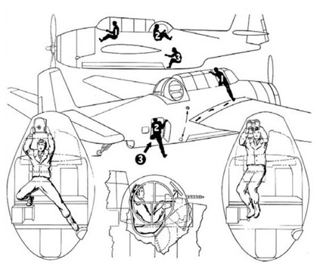
Figure: Crew Positions TBF/TBM Avenger, Source: Bureau of Aeronautics.
Officially, the third crew member was the radio operator. Instead of sitting under the canopy, he sat in the crew compartment that ran from floor to ceiling behind the bomb bay. Crew members called this space the tunnel. They also called it the “cheap seats”. It was noisy, smelly, and claustrophobic, and the radio operator was only connected to the pilot by an electrical intercom. If that connection broke, the radio operator was cut off. In front of the radio operator were several panels for the radio, radar, navigation, and weapons arming. On many missions, the radio operator used the radar to direct the pilot to targets. The radio operator basically ran a rudimentary combat information center.
For level bombing, the third crew member had a Norden bombsight. He could take over the aircraft for the attack. This required a view forward and down. When the bomb bay doors opened, this vantage point was provided by a glass window with an unrestricted view if bombs were not directly in the center of the bay.
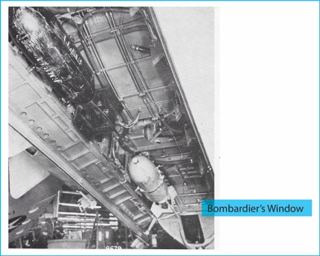
Figure: Sideways view of the Radio Operator’s Forward Viewing Window
However, level bombing was rare. At sea, high-level bombing nearly always missed maneuvering ships. Consequently, the Avenger was normally used as a glide bomber. In glide bombing, the pilot aimed the aircraft and released the bombs. The radio operator’s jobs were to arm the weapons, set drop interval between bombs with an intervalometer, and called out altitudes during the dive. In torpedo attacks, he also advised the pilot about altitude and distance to the target. Glide bombing was similar to dive bombing, only not as vertical.
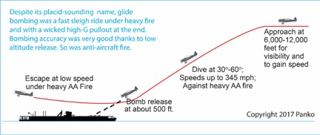
Figure: Glide Bombing Attack
Even when high-level attacks were made against land targets, it was typical to only use real bombardier in the lead aircraft. When the lead aircraft released its bombs, so did every other Avenger in the raid. Level bombing was often used with land targets because few merited risky glide bombing. However, quite a few did, such as enemy airfields. These had to be hit with glide-bombing attacks.
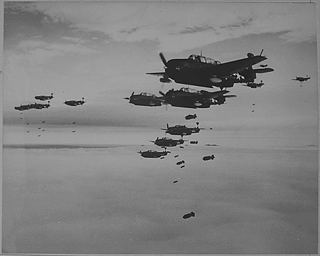
Figure: USS ESSEX based TBMs and SB2Cs on Level Bombing Attack, Hokadate, Japan, Source: National Archives Identifier 520989.
The radio operator also had a defensive role. If an Avenger was attacked from the rear, he turned around and manned the .30-caliber “stinger” machine gun at the back of the crew compartment. Compared to the .50-caliber machine gun in the powered turret, this was weak protection, but it could at least threaten fighters approaching from the back and below.
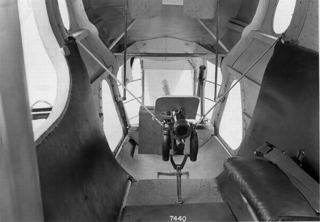
Figure: Radio Operator’s Stinger Machine Gun, Source: United States Navy from ww2db.com.
Near the end of the war, when the U.S. Navy was pounding heavily defended land targets, deaths among radio operators soared. There was no armor in the bottom of the tunnel as there was around the seats of the pilot and turret gunner, and of course, AA hit from below. By this point, it seemed better to add to the pilot’s workload and have him do the radio operator’s job as well as his own even in glide bombing. In high level bombing, most Avengers had no need for the radio operator to use the Norden bombsight as the bombardier. Normally, Avengers doing level bombing had to fly in large gaggles, with a single lead plane containing the bombardier. All the pilots of the other planes simply dropped their bombs on cue when the lead plane released its payload. Many squadrons dropped the radio operator from their crews late in the war.
**Note: YouTube video below gives a good view of the interior of the plane for the turret gunner and radio gunner.
Curtiss SB2C Helldiver (Training)
https://en.wikipedia.org/wiki/Curtiss_SB2C_Helldiver
"Then it was to the desert across from the Mexican border in El Central for gunnery in an airplane. I flew in a SB2C (Curtiss SB2C Helldiver) and had fun winning gunnery games. I had an advantage as I'd take off my parachute and kneel in the seat for more freedom and better shots - I also had no seat belts on and had a few thrills when I just barely caught myself from coming out of the plane during fast maneuvers.".
Bud Robbins - quote from Robbins Book Autobiography, unedited version.
Douglas SBD Dauntless (Training)
https://en.wikipedia.org/wiki/Douglas_SBD_Dauntless
"El Central, California - gunnery school, flew with SBD and SB2C".
Bud Robbins - quote from Military Timeline.
USMC Certificate of Satisfactory Service
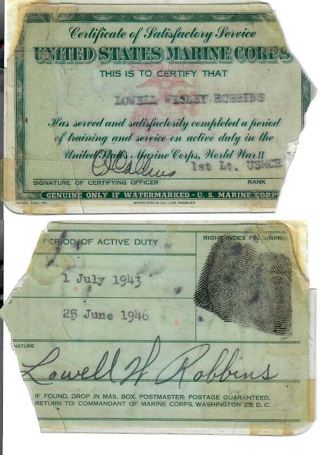
USMC Certificate of Satisfactory Service
Autobiographical Military Service Stories
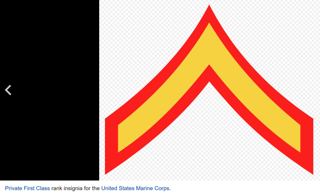
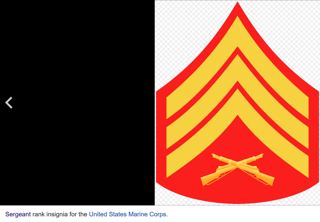
A Brief Autobiography: "On leaving High School, I went directly into the Marine Corps in special training at the University of Colorado. I left the University and was a air gunner in the Marines and served three years which included overseas duty in the South Pacific during World War Two. I was honorably discharged in June of 1946. "
. . . . . . . . . .
Biography for 50 Year High School Reunion:"Was in the Marine Air Force as a gunner in a TBM 3E Torpedo Bomber. Traveled the Pacific - Marshall Islands, Guam, Palau, Pelileu, Philippines, Okinawa and China before coming home. Was court marshaled a couple of times but they gave me an honorable discharge to get rid of me". (Biography for 50 Year High School Reunion)
. . . . . . . . . .
Robbins Book Autobiography, unedited version: I knew the draft would take me when I graduated so I signed up with the Marines for officer training at the University of Colorado at Boulder. I had to have a B average so I had to study my senior year and make A's to bring my C average to a B average.
I blew a big opportunity at the University of Colorado when I declined a second chance to stay there. My grades were poor but I did well in my final exams in Math and Military Science so they offered to let me stay but I decided to move on to boot camp as a PVT.
My father was in the Marines in World War I and wrote to me saying he had led his company in marksmanship and made Expert on the firing range. He gave me his score and I beat him about 3 points, led my company, made Expert and I believe this also made possible my first promotion the Private 1st Class. I also petitioned that I be allowed (as per the manual) an interview with the Commanding Officer. I requested flight training. They used my case to petition the Navy to have a Marine take flight training. The Marines got Navy flyers to fly their planes and then wanted Marines to take flight training. It didn't work but they put me in the Marine Air Force and I went to Ordinance School. While there, I took gunnery training, shot skeet and trap with a shot gun mounted on a turret. After 3 months, I graduated in the top 20% and made Corporal. I then went to gunnery school where I graduated in the top 10% and made Sergeant in 6 weeks. Then it was to the desert across from the Mexican border in El Central for gunnery in an airplane. I flew in a SB2C (Curtiss SB2C Helldiver) and had fun winning gunnery games. I had an advantage as I'd take off my parachute and kneel in the seat for more freedom and better shots - I also had no seat belts on and had a few thrills when I just barely caught myself from coming out of the plane during fast maneuvers.
I was shipped out for overseas duty and had a ball. We were sent by boat to Hawaii where I jumped ship for two days and tried to learn surfing and toured the island. I stayed with an old buddy Marine who packed parachutes. Then on to Marshall Islands by boat. They assigned me to Palau Islands and also assigned me to a fighter pilot. Everyone left except us. We later got separate orders. I could have probably gone home because I had my own orders. I went to Kwajalien by air. It's the island that every tree was blown off when they put an airstrip on it. I then went to Guam and explored the island for a week but got bored and caught a flight to Peleliu in the Palau Islands where I was supposed to be. It was a great life there. We climbed the hills where the battles had taken place and found many dead bodies - really only bones and skeletons - lots of ammunition and guns and some crashed planes. The booby traps were duds because of the heavy moisture. We swam about every day and the flora and fish were unique. I collected shells for those wanting to make bracelets. They had just finished a couple of tennis courts so I heisted a couple of the officers' tennis rackets and we were playing one day when the Commander and his Adjutant asked us to play. We had a ball and they wanted a standing date and we played a few more times but broke off as they wanted us at social events and we weren't officers. They were still complaining about the missing tennis rackets. We left Peleliu and went to Manila in the Philippines after failing to get there a couple of times because of weather. We were in two hurricanes and survived. We then went to Laoag on the top of Luzon and lived like the natives while we waited out another hurricane and then went to Okinawa as a step to China. We were to be the first squadron in the upper part of China. We experienced another hurricane but were on the ground instead of in the air. It blew four or five Navy ships on to the beaches, swamped about fifteen Marine planes they use for air-sea rescue and blew down officers mess that had a store of everything we needed for our stay there. We even commandered a jeep. We were the last plane to leave Okinawa, we circled to gain altitude, smelled gas and called MAYDAY as the engine went dead. We came back in just short of the runway but made it and got to extend our stay for another week. We picked up an arsenal of guns and had gunnery practice and swam and looted the planes in the bay.
We flew solo to Tsingtao China, which is down the coast south of Tientsin on the Yellow Sea across from Korea. We set up headquarters in a walled village and I ran the office and scheduled flights. We patrolled Chiang Kai- Shek land and kept track of the Communists and improvised a means of keeping the local kids from stealing all our gear. For relaxation we would go into town for a shave, rub down, massage, pedicure, manicure, hair cut - you name it - and some went in for other things. We were kings, the saviors of the people and at first had the Flying Tiger flag on our backs and then later the American Flag so all would know that we had replaced the Japanese.
After five and a half months we were sent home for discharge. When I got in (by boat) to San Diego, my father had had a heart attack and I got emergency leave to go home then returned to get an honorable discharge. Why! I'll never know as it climaxed two court marshalls and a couple of dozen infractions. It was a fabulous experience and joyful time of my life.
Selective Service Classification
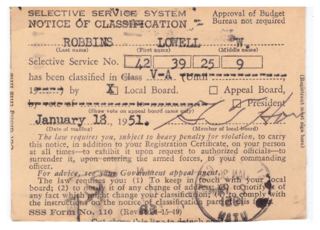
Selective Service Classification - V-A classification means "too old".
Military Service Thank You
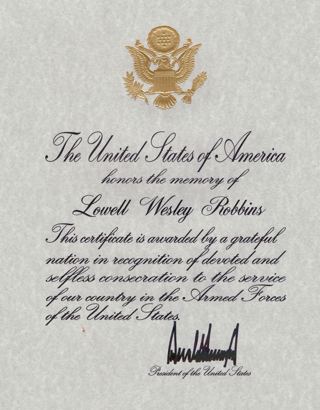
Military Service Thank You
Military Photos
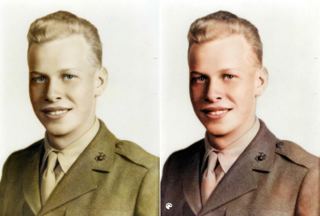
Bud has the yellow tie.
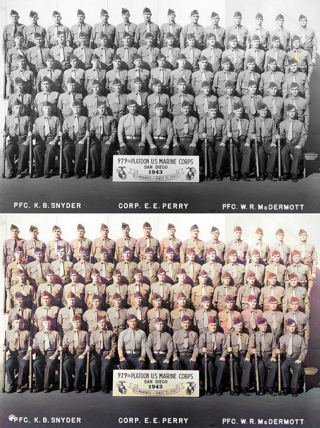
Individuals numbered - next photo has each individual's name
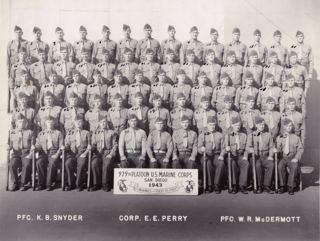
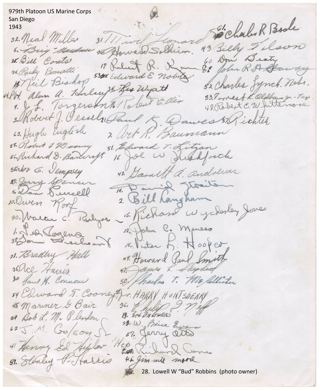
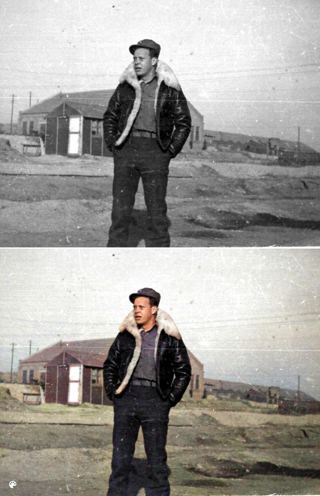
Military Photos
Timeline
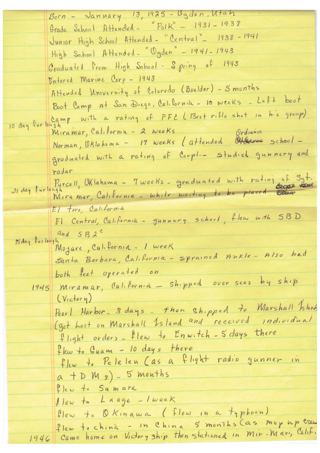
*Notes narrated by Bud Robbins, transcribed by Jalaine Robbins
Timeline: University of Colorado, Boulder Colorado - 5 months Boot Camp in San Diego, CA - left boot camp with a rating pf PFC (best rifle shot in his group) 10 day furlough Miramar, California - 2 weeks Norman, Oklahoma - 17 weeks, attended Ordinance School. Graduated with a rating of Corporal, studied gunnery and radar Purcell, Oklahoma - 7 weeks, graduated with a rating of Sergeant 21 day furlough Miramar, California - while waiting to be placed El Toro, California El Central, California - gunnery school, flew with SBD and SB2c 15 day furlough Mojave, California - 1 week Santa Barbara, California - sprained ankle, also had both feet operated on Miramar, California 1945 - shipped overseas by ship, "Victory" Pearl Harbor, Hawaii - 3 days Kwajalien Atoll, Marshall Islands - got lost on Marshall Island and received individual flight orders. Enwitch - 5 days (most likely Enewetak Atoll, Marshall Islands) Peleliu (Palau Islands) - flew to Peleiu as a flight radio gunner in a Grumman TBM-3E Avenger torpedo bomber - 5 months Samara(No reference to Samara found, could be Manila as Bud states elsewhere he was in Manila before Laoag) Laoag (Tip of Luzon Island, Philippines) Okinawa - flew in a typhoon Tsingtao (Qingdao), China - flew to China. In China 5 months as a mop up crew Miramar, CA - 1946 Came home on "Victory" ship, then stationed in Miramar, CA.
Maps
University of Colorado Boulder
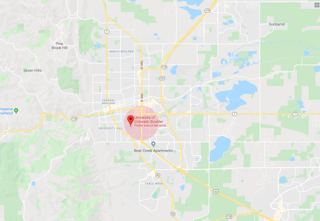
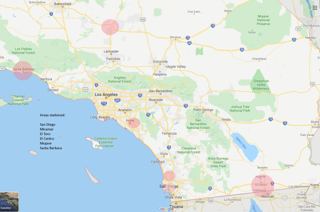
California - San Diego, Miramar, El Centro, El Toro, Mojave, Santa Barbara
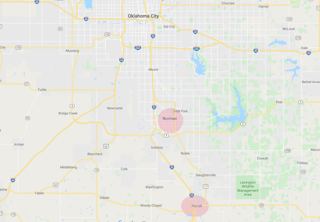
Oklahoma - Norman, Purcell
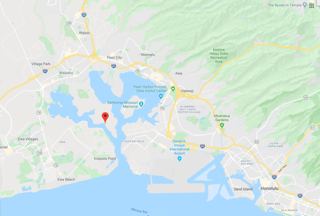
Pearl Harbor, O'ahu, Hawaii
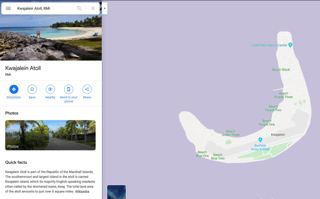
Marshall Islands, Kwajalien Atoll
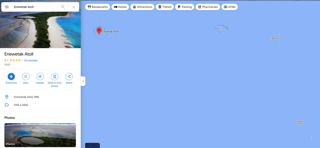
Marshall Islands, Enewetak Atoll
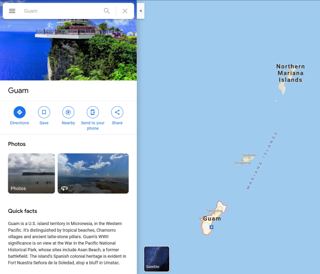
Guam
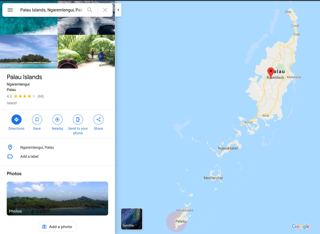
Peleliu, Palau Islands
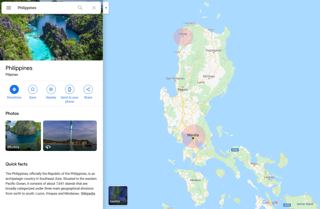
Manila and Laoag City, Luzon, Philippines
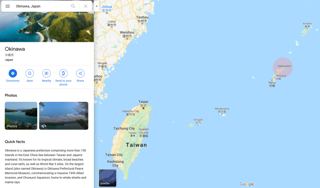
Okinawa, Japan
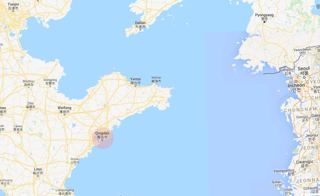
Tsingtao (Qingdao), China
Maps
GENEALOGY | ABOUT